Monday, June 11, 2012

Radiological Emergency Plan: North Anna Nuclear Power Station

On March 11, 2011, the Tōhoku-Chihou-Taiheiyou-Oki Earthquake and Tsunami struck Japan's northeastern coast with devastating consequences. Roughly 20,000 people perished that day. In addition, three reactors at the Fukushima Dai-ichi Nuclear Power Station (NPS) incurred fuel meltdowns with massive releases of radioactive material into the air and the ocean, contaminating large swaths of land. Roughly 80,000 residents had to be evacuated from the vicinity of the NPS and have not been able to return home.

About five months later, the August 23 Virginia Earthquake precipitated the emergency shutdown of the two pressurized light water reactors at North Anna Nuclear Power Station (NPS) roughly 35 miles from my home. According to the U.S. Geological Service, the station is located at a distance of only 8 miles from the quake's epicenter and 20 miles from a quaternary fault zone. Seismologist Dr. James Martin of Virginia Tech. gave a comprehensive interview on the quake to Beverly Amsler aired on WVTF Radio IQ's Evening Edition for Nov. 22, 2011. The events made me wonder what a radiological emergency similar to that in Japan would entail in the U.S.

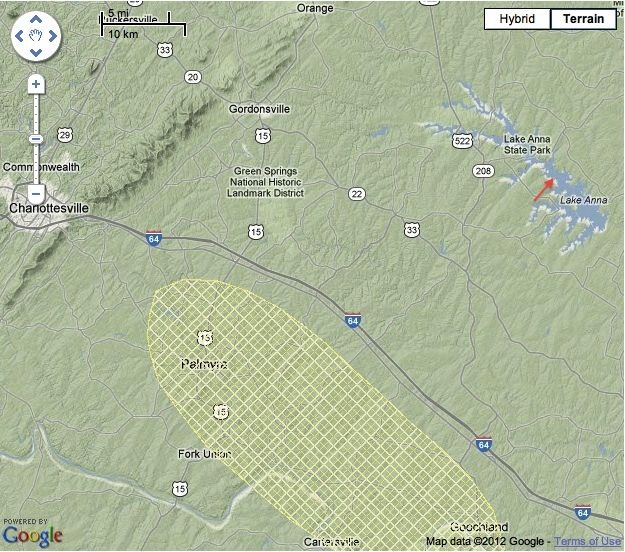
Area of quaternary faults and liquefaction in less than 15,000 years (hatched; source: USGS). The arrow points at the location of North Anna NPS. The epicenter of last Summer's Virginia quake was located near the junction between state routes 22 and 208.

When a utility company applies to the U.S. Nuclear Regulatory Commission (NRC) for the license to build a nuclear power reactor, an emergency plan for the eventuality of a radiological accident must be submitted. The plan must conform to federal regulations (10 CFR § 50.47 Emergency Plans). Dominion, the operator of North Anna NPS, is planning to construct a third unit on the station's premises and has hence developed such plan.

Examining Dominion's "North Anna 3 Combined License Application, Part 5: Emergency Plan, Revision 0 November 2007", reveals that much of the responsibility for the immediate decisions to be taken in the course of a severe reactor accident rests with the station operator, that is, primarily on the shoulders of the station's Emergency Coordinator (page II-1 of the proposed emergency plan). This person is instructed to collect information about the radioactive contamination monitored in the surroundings of the station, estimate the source term, that is the amount of radioactivity released from the failed reactor, determine the prevailing winds and precipitation, dispersing the radioactive matter, and constantly keep the relevant local, state and federal agencies up to date about the evolution of the accident.

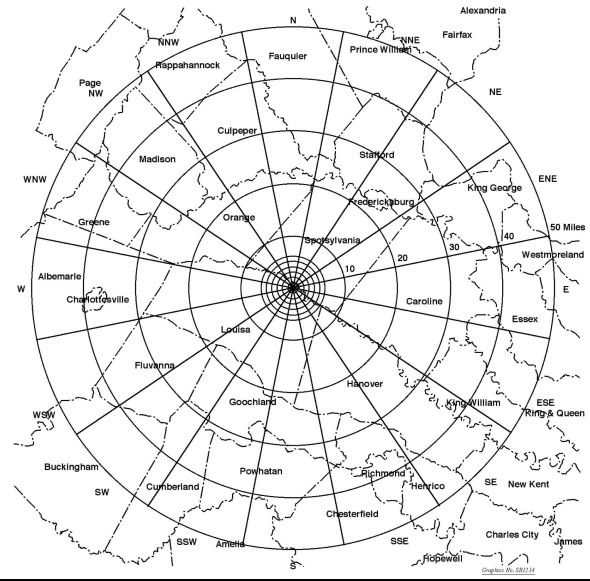
Map showing county lines and distance radii of Emergency Planning Zones proposed for North Anna NPS Unit 3 (source: Fig. I-2; Dominion).

Precise recommendations to the public depend on the source term and the progression of the plume in which the radioactivity is dispersed. The anticipated immediate protection measures are contingent mainly upon the distance from the power station. Radii of action are drawn (see drawing above). In addition to the protection of station personel (site emergency), the greatest concern lies with the safety of residents living within a 10-mile radius around the station, for whom precise instructions for health protection, evacuation and shelter have been planned (general emergency). This area is designated as the Plume Exposure Pathway Emergency Planning Zone. Radio stations periodically test emergency alert announcements (texts and further details can be found in the Commonwealth of Virginia Emergency Alert System Plan). Sirens alert residents to tune into local radio and TV stations for detailed announcements. Residents living within the 2 mile perimeter around the stricken NPS and within 5 miles straight downwind, including a margin on both sides (keyhole pattern), will be asked to evacuate immediately. Other residents within the 10-mile perimeter will be asked to stay indoors (NRC Backgrounder on Emergency Preparedness at Nuclear Power Plants).

The plans for residents beyond 10 miles depend on the amount and the duration of the release of radioactive matter from the reactor. The 50-mile radius encompasses the largest territory taken into consideration in the station's emergency plan. This area is designated as the Ingestion Exposure Pathway Emergency Planning Zone. Dominion set up a series of monitoring stations around the station. Near-real time ionizing radiation measurements available to the public within 100 miles from North Anna NPS, are disseminated by only two Radnet stations: one in Richmond and one in Harrisonburg, Virginia.

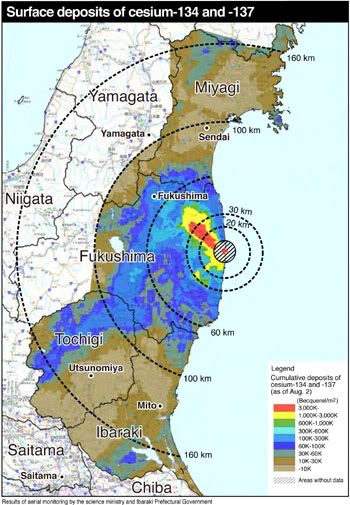
The color-coded map shows the magnitude of the fallout of cesium-134 and cesium-137, two major radioisotopes released after the severe nuclear reactor accidents at Fukushima Dai-ichi NPS in March last year. The deposits were mapped at the beginning of August, 2011. Radii are superimposed for orientation. Note, the plume's impression in red and yellow (source: MEXT).

Local wind and precipitation mainly dictate the shape of the plume in which the radioactivity is transported and disperses. To provide an example the color-coded radiation map above shows the overland plume-shaped radioactivity dispersal reconstructed with computer models from radiation monitor recordings after last year's severe accidents at Fukushima Dai-ichi NPS.

Average prevalence of wind directions at Louisa County Airport, Virginia, compiled from data collected between 1999 and 2011 (source: weatherspark.com).

In a hypothetical release at North Anna NPS resembling that of Fukushima, local weather conditions could produce a similar plume heading in a different direction. Wind speed and direction recorded at Louisa County Airport (see above) a few miles from North Anna NPS suggest that prevalent local winds blow on average from South/Southwest to North/Northeast. The plume would most likely progress toward Northern Virginia. Dispersal to the South toward the Richmond Metropolitan Area represents the second most probable direction.

The distance over which the plume eventually extends depends on the amounts of radioactivity released, the altitude of the release, wind speeds affecting the release, and precipitation. In Japan, the plume barely impacted Fukushima City, 35 miles from the nuclear reactor accidents. Note, however, that prevailing winds blew much of the airborne radioactive material out to sea.
Dominion's proposed emergency plan is most concerned with immediate impact after a severe radiological emergency. The long-term evolution of a wide-spread radioactive contamination can only be extrapolated from experiences after the Tchernobyl reactor disaster in 1986 and the ongoing contamination and clean-up around Fukushima Dai-ichi NPS. Regardless of the uncertainties, it seems only prudent to consult our local Radiological Emergency Plan, if we live within the 50-mile ingestion zone around a nuclear power station.

Acknowledgement
I thank the members of the simplyinfo.org discussion group for their cogent input, without which this post would not have been possible.

Relevant Sources

Friday, April 13, 2012

The Value of RadNet Ionizing Radiation Detection

In this post, I discuss uses of ionizing radiation measurements made available to the public by the U.S. Environmental Protection Agency's RadNet stations. In particular, I examine the usefulness of RadNet data for the early detection of radioactive fallout from distant radiological emergencies. As example, I use the reactor accidents at the Fukushima Daiichi Nuclear Power Station in the wake of the Mar. 11, 2011, Tōhoku-chihō Taiheiyō Oki Earthquake and Tsunami.

Iodine-131 and cesium-137 are prominent radioisotopes released after severe nuclear reactor accidents with fuel meltdowns. The decay of these isotopes produces a mix of beta and gamma radiation. The gamma radiation is emitted when the atomic nuclei transmute through intermittent energy states at isotope-specific energies.
Near-real time air filter gamma gross count rates measured in nine energy ranges at the RadNet station in Harrisonburg, Virginia (courtesy EPA). Because of the disparate values, the count rates are scaled logarithmically on the ordinate, compressing the peaks at high count rates. 
I used air filter measurements from the RadNet station in Harrisonburg, Virginia. The EPA publishes graphs of hourly gamma radiation gross count rates in nine energy ranges (see graph above).

Gamma spectrum of iodine-131 (Arena, 1971). Counts/channel are plotted on a logarithmic scale versus energy [keV]. Peaks are labelled in MeV.
Iodine-131 with a physical half-life of 8.05 days and an effective half-life in the whole body of 7.6 days possesses its greatest energy peak at 360 keV, a second-ranking peak at 280 keV, a third peak at 638 keV and a fourth peak at 724 keV (Arena, 1971). The lower couple fall into range 3 (200-400 keV) , whereas the higher couple fall into range 5 (600-800 keV) in the RadNet graph.

Gamma spectrum of cesium-137 (Arena, 1971). Counts/channel are plotted on a logarithmic scale versus energy [keV]. Peaks are labelled in MeV. 
By contrast, cesium-137 with a physical half-life of 30.17 years and an effective half-life in the whole body of 70 days emits gamma radiation at 662 keV, falling into range 5 of the RadNet graph. However, backscatter (Compton effect), that is low-energy detector counts produced by incomplete energy transfer between the ionizing radiation and the detector material, contributes a considerable fraction of the total count rate to range 3. Although the precise shape of the spectral curves shown above depends on the radioactivity of the sources and the instruments used for the measurement, the energy peaks remain invariable and representative. Therefore, the spectra may can be employed for the demonstration of principles.

Partial integration of the areas under the spectral curves taking the logarithmic scale of the counts/channel into account suggests that the iodine-131 decay contributes about 91 percent of the total count rate summed over both ranges to range 3, whereas cesium-137 decay will contribute about one third to this range. Therefore, if both isotopes are present in the sample, the count rate measured in range 3 does not exclusively reflect iodine-131 decay, and iodine-131 will also contribute to the count rate measured in range 5, though to a smaller degree than cesium-137. Despite this cross-contamination, a prominent increase in range 3 suggests the presence of iodine-131 and in range 5 that of cesium-137. Furthermore, the EPA provides offline post-hoc data for identified radioisotopes.

Regardless of its low spectral resolution, the real-time RadNet graph may potentially have its uses for the identification of a radiological incident. An increase above the average counts per minute (CPM) measured in ranges 3 and 5 beyond three standard errors of the mean can be considered statistically significant with 95 percent confidence. Mean count rates measured in the past can be queried in the RadNet database. Sequences of up to 400 measurements can be downloaded in a batch.

To determine mean count rates for the two energy ranges of interest, that is ranges 3 and 5, I chose the period between Feb. 22 and Mar. 10, 2011, and subsequently compared the means averaged over this epoch to the count rates observed in the same epoch this years. Radioactive decay adheres to the Poisson distribution in which the standard error is equal to the square root of the mean count rate. If the current count rate exceeds the mean by three standard errors, the probability of the increase being random is less than five percent.
Graph of gamma gross count rates measured in nine energy ranges taken from air filter samples at the RadNet Station in Harrisonburg, Virginia. The bottom lines of the red boxes indicate three standard errors above the mean count rate of the same epoch a year ago.
The graph above shows that this year's count rates statistically significantly exceeded the mean in the examined time window on roughly a handful of occasions. However, most comprise all energy ranges except 9 (magenta). If increases were only detected in range 3 (blue), we would most likely be confronted with a statistically significant presence of iodine-131. By contrast, a statistically significant increase in ranges 3 (blue) and 5 (yellow) would most likely indicate the presence of cesium-137.

Concomitant increases in gross beta count rates would further affirm the conclusions above, because both radioisotopes also emit beta radiation. Note, however, that the above assertions are purely based on statistical probability and causal inference. Great care must be taken to establish reasonable cause.

Iodine-131 and cesium-137 can be distinguished with time, using the difference in physical half-life between the two isotopes. Iodine-131's half-life is at 8.05 days considerably shorter than that of cesium-137 at 30.17 years. Following a pulse release of both isotopes into the atmosphere, iodine-131 should mainly contribute to the count rates measured early after the release. When the samples are remeasured ten half-lives later, that is after 80 days, the contribution of iodine-131 to the count rate will have diminished to one-thousandth. By contrast, the contribution of cesium-137 with its 30-year half-life is going to persist. Therefore, if repeated measurements of the same sample ascertain a decline in count rate commensurate with iodine-131's half-life, the radioisotope was present in the sample, and the remainder ought to be cesium-137.

Though the RadNet measurements may not immediately lend themselves to the distinction between iodine-131 and cesium-137, they may prove useful for the detection of radioactive fallout from a distant radiological accident. To test this idea, I tapped into the data collected at Harrisonburg in the weeks after the catastrophic nuclear reactor failures at the Fukushima Daiichi Nuclear Power Station situated on the shores of the Pacific Ocean 160 miles north of Tokyo in early March last year, that is between Mar. 12 and Mar. 28, 2011.

The station's reactors incurred loss of cooling in the wake of a magnitude-9 earthquake on Mar. 11, 2011, followed by 15-meter high tsunami waves inundating the structures (TEPCO press release with the title "Analysis and evaluation of the operation record and accident record of Fukushima Daiichi Nuclear Power Station at the time of Tohoku-Chihou-Taiheiyou-Oki-Earthquake," dated May 23, 2011). The nuclear fuel in three operating reactors melted down, producing great amounts of hydrogen. Between Mar. 12 and Mar. 15, hydrogen that had accumulated in the reactor buildings triggered massive explosions devastating the top floors of the structures and releasing vast amounts of radioactive matter into the atmosphere.

The first unit, Unit 1, exploded in the early afternoon of Mar. 12. The second unit, Unit 3, exploded two days later, and the third unit, Unit 4, though it was shutdown for inspection at the time, incurred an explosion in the early morning of Mar. 15. The reactor building of Unit 2, which was operating, suffered minor visible damage. However, since Unit 2's fuel melted, radioactivity was released from this reactor as well.

 Gross count rates from air filter samples collected at Harrisonburg, Virginia, over roughly two weeks after the first radioactive release from Fukushima.
Iodine-131 and cesium-137 were prominent in the airborne releases from the damaged reactors. The graph above depicts the gamma gross count rates collected in nine energy ranges at Harrisonburg over roughly two weeks after the first radioactive release from Fukushima, the statistical significance thresholds (dashed black lines) in ranges 3 (dark blue line) and 5 (yellow line), as well as the gross beta count rate (dashed red line). Peaks of significant gamma gross rate increases are evident in almost all energy ranges. None was confined exclusively to ranges 3 and 5. The light-blue line above the abscissa indicates the period in which the Fukushima Daiichi Nuclear Power Station incurred hydrogen explosions.

March 14 was the first day after the Fukushima Daiichi Nuclear Power Station began to release vast amounts of radioactivity, on which Harrisonburg registered significant peaks in gamma ranges 3 and 5 concomitant with an increase in beta gross count rate (dashed red line). A second such coincidence followed on Mar. 15. Then a triplet of coincident peaks followed on March 17, 19 and 20 (light blue dots above the abscissa). Because the peaks are spaced in about the same time intervals as the three hydrogen explosions at the Fukushima Daiichi Nuclear Power Station, this triplet of peaks represents the most probable harbinger of the arrival of fallout from Fukushima in Virginia, suggesting that radioactive airborne particulate from Fukushima reached Harrisonburg in five days.

The suggested time of arrival is a day ahead of that predicted by the cesium-137 dispersion model of Winiarek and others (2011) at the Centre d'Enseignement et de Recherche en Environnement Atmosphérique (CEREA), Marne la Vallée, France, and two days in advance of that of the iodine-131 dispersion modeled by Wotawa (2011) at the Zentralanstalt für Meteorologie und Geodynamik (ZAMG), Vienna, Austria.

Global iodine-131 dispersion after the Fukushima reactor accidents, 2011, according to the simulation model by Wotawa (2011), ZAMG, Vienna, Austria. 

Taking the above findings together, RadNet air filter count rate measurements seem to provide superb sensitivity for the detection of minute traces of airborne radioactive material, permitting us to identify distant radiological accidents half ways around the globe, if examined in proper factual context. Certainly, RadNet stations represent potent tools capable of alerting us to fallout from radiological accidents closer to home.

References

Monday, March 19, 2012

Project X-12: Borst's Imaginary Nuclear Locomotive

After half-a-century experience with the commercial use of nuclear power, it may seem difficult to conceive the sustainability of a nuclear-powered train engine.

In 1954, however, Professor Lyle B. Borst and his colleagues at the University of Utah pursued a concept for a locomotive powered by a nuclear reactor. Babcock & Wilcox Co. co-designed the reactor in a private venture. The project was dubbed X-12 and attracted the interest of five railroad companies, nine manufacturers, and the international media [1,2]. The locomotive was projected to cost 1.2 million dollars in 1954, double the price of four contemporary diesel units coupled together to produce the same horse powers.

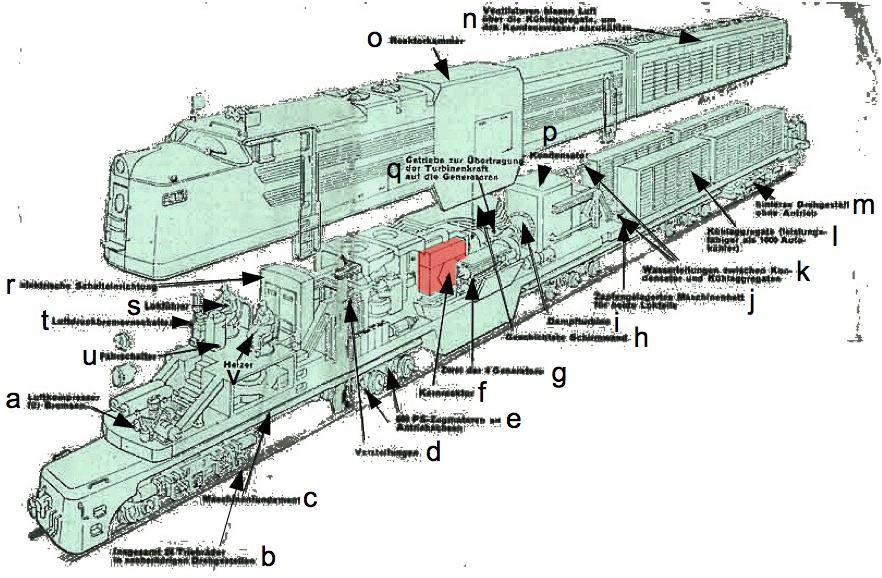
Artist's rendering of the proposed X-12 nuclear powered locomotive from a 1954 hobby article [1] (a - air compressor for brakes; b - 24 driving wheels in six-wheeled trucks; c - engine platform; d - heavy-duty bridge truss supporting the reactor's weight; e - 600 hp electric motors; f - nuclear reactor; g - two of four main generators; h - two-chambered shielding; i - main steam turbine; j - pivoted articulation; k - piping connecting condenser and chiller bank; l - chiller bank; m - trailing truck; n - fans blowing air over radiators for cooling; o - reactor containment; p - condenser; q - gear box; r - electrical cabinet; s - engineer; t - regulator/throttle; u - brake; v - fireman;).
Operating on only 14 kg liquid fuel, the locomotive was envisaged to span 58 meters in length and muster 7,000 horse powers, rivaling the remarkably strong Ae 8/8 electric locomotives of the Swiss BLS Railway of the same epoch. These double units with Bo'Bo'+Bo'Bo' wheelbase (UIC classification) were only half that long.
Ae 8/8 near Kandersteg, Berne, Switzerland (courtesy: Klaus Kort).
Though, the X-12 would theoretically reach 60 miles/h in breath-taking 3 minutes and 32 seconds, pulling a 5,000-ton train, the nuclear locomotive would have weighed 360 tons. The reactor's radiation shielding mustered 200 tons alone. By contrast, the whole afore-mentioned electric Ae 8/8 weighs roughly as much as the shielding of the X-12 (180 metric tons).

The X-12's stream-lined body emulated the diesel locomotive design of the 1950s [1,2]. The two-sectioned behemoth was to consist of a 38-meter long engine, with a cab up front and the power plant behind, plus a 20-meter long 'tender' carrying the radiators for cooling turbine steam. The assembly was conceived to rest on an articulated platform riding on a (Co'Co')(Co'Co')(4) wheelbase (UIC classification).

The power plant was to consist of the nuclear reactor, the main steam turbine for power generation as well as steam condensers and chillers. A gear box coupled the turbine shaft to four electric generators.

The unavoidable massive radiation shielding called for small components in the engine room. At a rotor shaft length of only 120 inches and a diameter of only 24 inches, the team accomplished to design powerful space-saving generators that, despite their small size, could cope with the demands of the twelve 600-horsepower electric motors driving 24 wheels.

Further accommodating the limited space available, the engine's reactor was to possess a peculiar design. The reactor core was to be filled with liquid uranium oxide dissolved in sulphuric acid, providing greater symmetry for neutron fluxes at smaller neutron loss than the other popular, less efficient designs that used solid fuel packed into rods [3].
Borst's reactor schema shown in his patent [3] (2 - transverse section on line 2-2; 10 - fuel chamber; 12 - cylindrical pressure wall; 18 - coolant tubes; 24 - recombiner; 26 - external steam separator; 28 - riser; 30 - downcomer; 32 - vapor outlet line; 34 - coolant pump; 36 - suction line; 38 - coolant inlet chamber line; 45 - primary shield; 46 - fuel circulation baffles; 47 - u-shaped primary shield wall; 49 - primary shield roof; 50 - turbine; 51 - catalyst; 52 - liquid fuel surface; 53 - recombiner condenser; 54 - recombiner condenser discharge line; 55 - recombiner condenser feedwater line; 56 - recombined water return line; 58 - emergency cooling heat transfer tube; 60 - inlet header of emergency cooling heat transfer tube; 62 - outlet header of emergency cooling heat transfer tube; 64 - control rod;).
Furthermore, the heat transfer from a homogeneous liquid core is superior to that of a heterogeneous core consisting of rods because of the rod cladding and the uneven coolant flow among the rods. These advantages lend themselves particularly to small nuclear reactors that must produce high energy output. The Nobel Prize-laureates Eugene Wigner and Enrico Fermi developed the original reactor, known as aqueous homogeneous reactor (AHR), in the 1940s as an intermediate step to thorium reactors (Hargraves and Moir, 2011[4]). A circulating solution of 242 liters uranyl sulphate, a yellow-green salt, served as fuel [4].

The fuel core of the X-12's reactor was supposed to measure only 36 inches in diameter and 10 inches deep. The reactor pressure vessel, clad in an eight-inch steel primary shield, was made to fit into the 13 x 13 x 9 feet cavity of a secondary fluid-tight shield, also made of eight inch steel, encompassing the middle section of the engine and measuring 15 by 15 by 10 feet on the outside. The space between the two shields was to be filled with high viscosity hydrocarbon fluid to absorb internal motion on accidental impact and a hydrogenous shielding material to absorb more radiation.

The reactor consisted of a cylindrical reactor pressure vessel, shorter than wide, in which a steam-driven pump force-circulates the core's fluid, representing the primary coolant circulation for nuclear fission heat transfer. For secondary cooling, roughly 10,000 ¼-inch stainless steel tubes, traversing the core, join an inlet and an outlet chamber attached to each end of the reactor pressure vessel. The water-filled chambers, covering a large part of the reactor core surface, were thought to double as coolers and neutron reflectors, diminishing the escape of neutrons from the core. Coolant pumped through the tube and chamber system feeds steam to the main turbine. An additional coolant loop circulates through the chiller banks in the tender, cooling the turbine's exhaust steam in the main condenser.

As in any nuclear power plant, the water presumably needed to be filtered for contaminants before reuse, its chemistry needed to be balanced, and some water would be lost in the process. The engine could not do without filter beds and a make-up tank.

At full power, the engine's reactor would produce 30,000 kW thermal. Despite, the fuel in the reactor pressure vessel was not going to exceed 240 ℃ (460 ℉) at 4.5 MPa (megaPascal) gauge and, therefore, would not boil. The secondary cooling water would reach 207 ℃ (405 ℉) at 1.7 MPa gauge. These values are low compared with pressurized light water reactor (PWR) widely used in contemporary commercial nuclear power plants. That design must harness water temperatures of up to 315 ℃ (600 ℉) at 15.5 MPa.

Because of the intense radiation, however, almost half the solvent would dissociate into hydrogen and oxygen (radiolysis) within 13 minutes. Hence, the liberated hydrogen needed to be continuously recombined with the oxygen in a catalytic platinum recombiner/condenser installed above the pressure vessel. The recovered water could subsequently be returned into the core.

The liquid fuel concept allowed short-lived, neutron flux-hampering, volatile fission products to simply bubble out of the core fluid, and elegantly combined neutron moderation and efficient heat transfer. In addition, spent fuel could be exchanged without opening the reactor pressure vessel, posing a crucial handling advantage, because the reactor would have needed refueling every two to four months.

We may wonder whether the locomotive would have proved safe to operate. Borst and his colleagues hardened the reactor components to withstand collisions in an effort to prevent radiation releases and fuel spills. The reactor control rods, mounted at 60 degree angle, possessed shear points that would break on impact at accelerations equal to or above 0.2 g, lowering the rods into the core and scramming the reactor. Coolant forced through a subset of tubes traversing the core was supposed to help remove the resulting decay heat from the core in such emergency shutdown.

Professor Borst argued that ultimately the benefit versus cost of fuel compared with other sources of energy would decide the X-12's future. In order to sustain a chain reaction, most nuclear fuel used in commercial applications consists of uranium-238 enriched with the more fissile uranium-235 beyond its natural prevalence of 0.7 percent. In commercial light water nuclear power reactors burning solid uranium oxide, the enrichment is in the order of 3.5 percent. By contrast, Prof. Borst intended to run his reactor with weapon-grade highly enriched uranium, that is uranium-238 enriched with uranium-235 to more than 85 percent. In fact, his patent application called for 7 kg pure uranium-235. At today's DOE prices, one filling of fuel for the locomotive would cost 104 million dollars.

The fission products of uranium-235 mainly comprise radioactive isotopes of barium, cesium, iodine, strontium, and xenon, of which the highly volatile iodine-131, with a half-life of 8 days, and barium-140, with a half-life of 13 days, pose an immediate health hazard, when released into the environment. Accidental releases of cesium-137 and strontium-90 with half-lives of about 30 years are of long-term concern. Professor Borst mentions little about the enormous expenses to provide radiation safety during fuel handling and maintenance, and eventually the decommissioning of highly radioactive components at the end of the reactors' life span. Moreover, reprocessing of used nuclear fuel has been wrought with unresolved technological pitfalls to date, and endstorage sites where highly radioactive waste can be safely and indefinitely stored remain elusive in the U.S.

Three scores ago, the advent of nuclear power's commercial use was greeted with exuberant enthusiasm, promising a future of limitless energy and boundless applications. Despite the optimism, Prof. Borst's idea of a mobile reactor must have been met with skepticism from its conception. A prototype X-12 locomotive never gained traction as much as we know, probably because of the enormous investments already involved in the development of the engine alone.

It seems certain that cost weighed on the minds of the railroad company executives as heavily as the X-12 might have weighed on the tracks. Without substantial government subsidies, particularly for highly purified uranium-235, the railroad companies could not have run such locomotive cost-effectively. Liability insurance would have been enormous. I counted a dozen major U.S. train wrecks in 2011 alone. Moreover, safety and security of the use of nuclear-powered train engines would pose daunting challenges to homeland security today.

Confronted with what arguably must have seemed insurmountable obstacles from the project's conception, Borst and the University of Utah appeared in no particular hurry to obtain approval for a patent [3]. The parties applied in 1955. The application was eventually approved in 1964, consuming almost a decade. At best, the X-12 may add an illustrious conversation piece to a model railroad today.

References
  1. "Auf Bahnsteig 3 - Atom-D-Zug", hobby, July 7, 1954.
  2. "The atomic locomotive. A physics professor's practical dream, the massive X-12 could run for months on a charge of U-235." Life, Jun 21, 1954.
  3. Borst LB (1964) Nuclear reactor for a railway vehicle. U.S. Patent № 3,127,321.
  4. Hargraves R, Moir R (2011) Liquid Fuel Nuclear Reactors. American Physical Society Forum on Physics & Society.